|
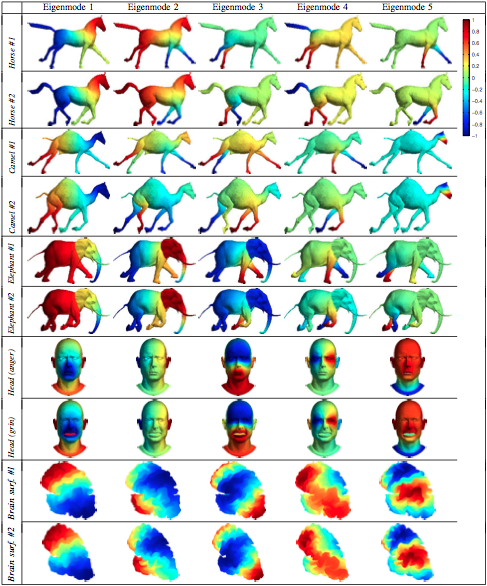
FOCUSR [1,2] is novel algorithm for dense vertex correspondence between two surface meshes. It benefits from the speed of direct matching of features over a surface and uses spectral correspondence as a mean of regularization. Spectral methods have been used for shape matching by comparing the lowest-frequency (smooth) eigenvectors of a graph Laplacian (representing inherent geometric properties of the mesh surfaces, see Fig. 1). FOCUSR takes advantage of the smoothness of these lowest-frequency eigenvectors to regularize an embedding containing any set of extra features (e.g., metrics derived from the mesh, or external measures).
|
|
Eigenvectors of the graph Laplacian of a mesh represent inherent geometric properties of this surface. For  vertices, let
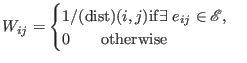
  be the weighted adjacency matrix describing the connections between the vertices. Given a distance metric
 between points
  and
and  :
:
The distance metric can be based on the distance between vertices:
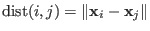 , or if additional features
 are used (e.g., surface curvatures, mesh texture, virtually any extra measurements):
where
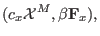
 is the concatenation of the 3D coordinate values
 with the
  feature values
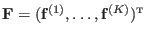 , while
  is a weighting parameter for each feature.
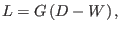
The general Laplacian operator is formulated as the
 matrix with the form:
 |
(3) |
where  is the degree matrix (diagonal matrix with
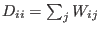 ), and
  is the diagonal matrix of node weights. Typically in spectral correspondence
is set to identity
is the diagonal matrix of node weights. Typically in spectral correspondence
is set to identity
 , or to
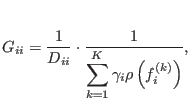
 . However, it is proposed to set
as any meaningful node weighting (e.g., positive feature magnitudes):
. However, it is proposed to set
as any meaningful node weighting (e.g., positive feature magnitudes):
where  is the node degree (i.e.,
  ),
is the previously mentioned feature weights, and
),
is the previously mentioned feature weights, and
 is a function that enforces positive values (e.g.,
 or
or
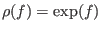 ). The denominator in Eq. (5) contains the sum of the influences of each feature on vertex
  . We used
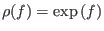 to promote correspondence between nodes having the largest feature components (which we assume indicate greatest significance).
is the node degree,
the previously mentioned feature weights, and
a function that enforces positive values on node weights (e.g.,
or
).
The right eigenvectors of the Laplacian matrix  comprise the graph spectrum


 . The values over surfaces for the five lowest frequency eigenvectors are shown on Fig. 1, and illustrates the stability of these eigenvectors between articulated or highly deformable shapes. here,
 represents the 3D coordinate in space (i.e.,
  ), and the superscripted
 represents the
 th
spectral coordinate (i.e., the
th
eigenvector of the graph Laplacian. Each eigenvector
th
spectral coordinate (i.e., the
th
eigenvector of the graph Laplacian. Each eigenvector
 is a column matrix with
values, and represents a different (weighted) harmonic on a mesh surface that corresponds to an inherent property of the mesh geometry. The
values
is a column matrix with
values, and represents a different (weighted) harmonic on a mesh surface that corresponds to an inherent property of the mesh geometry. The
values


 give the spectral coordinates of node
(i.e., a coordinate in a spectral domain).
give the spectral coordinates of node
(i.e., a coordinate in a spectral domain).
The first eigenvector
 is the trivial (uniform) eigenvector, and the eigenvectors associated with the lower non-zero eigenvalues (e.g.,
 ) represent coarse (i.e., low-frequency) intrinsic geometric properties of the shape. The first of them
 is called the Fiedler vector, while eigenvectors associated with higher eigenvalues (e.g.,
 ) represent fine (high-frequency) geometric properties. For example, in Fig. 1, the values of
increase along a virtual centerline depicting the global shape of the models (a coarse intrinsic property), while the values of
) represent fine (high-frequency) geometric properties. For example, in Fig. 1, the values of
increase along a virtual centerline depicting the global shape of the models (a coarse intrinsic property), while the values of
 depict finer details of the models.
Only the first  lowest-frequency eigenvectors (
 and
and
 ) are of interest. In practice, these eigenvectors on both meshes needs to be reordered (their sign might be flipped, and due to algebraic multiplicity, eigenvectors of close eigenvalues might be swapped). Reordering is done by checking the values of these eigenvectors between pairs of closest points on the mesh surface (
 on mesh
  is the closest point of
  on mesh
  ). The matrix
  gathers all dissimilarities between eigenvector
  and
and  :
:
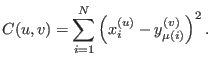 |
The Hungarian algorithm can find the optimal permutation  so each eigenvector
corresponds with
so each eigenvector
corresponds with
 .
.
Initial feature vectors  and
and  are extended with the reordered eigenvectors
and
to form an extended spectral embedding:
are extended with the reordered eigenvectors
and
to form an extended spectral embedding:
where  are weighting parameters based on the eigenvector frequencies and their reordering confidence, and
  a weghting parameter for each feature (e.g.,
 of Eq. (2) ).
These spectral embeddings are regularized using a non rigid point set correspondence. Coherent Point Drift (CPD) is used [1].
The extended spectral embeddings have been regularized with the smoothness of their spectral components. Closest points between these aligned embeddings reveal corresponding points between both meshes. The correspondence map can be further regularized in space in order to respect the spatial neighborhood of the meshes. The final correspondence map is given such that:
 |
(8) |
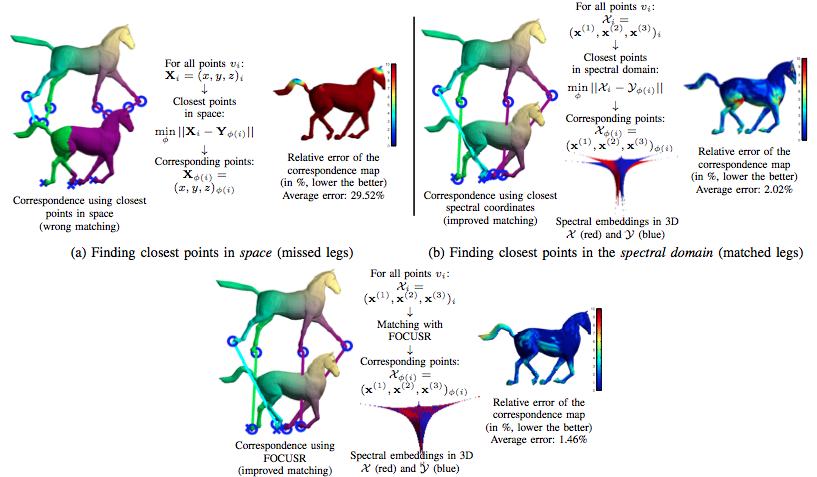
FOCUSR works on regular meshes when using its simplest setting (no additional features are required). Below, the illustration shows that finding closest points in space faces the challenge of working directly in the spatial domain, while the correspondences become clearer in the spectral domain. FOCUSR uses a different approach as it takes advantage of the smoothness of the lowest harmonics to regularize matching.
|
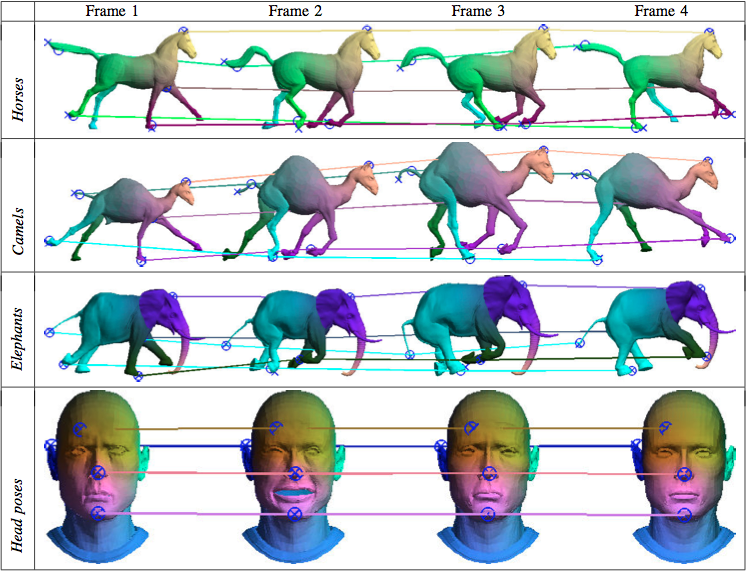
FOCUSR can match meshes undergoing important non rigid transformations and articulated meshes. Below are examples of galloping animals and of different facial expressions.
|
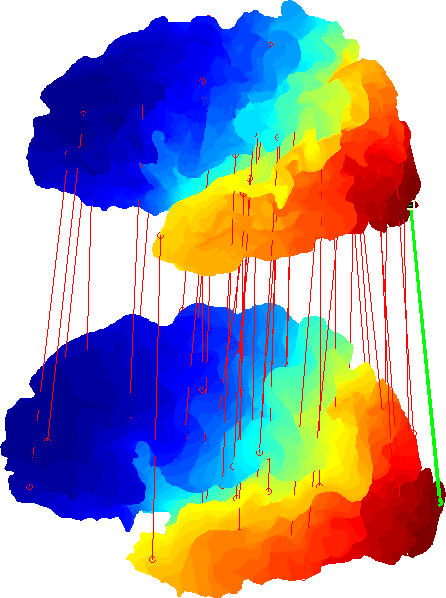
FOCUSR can also be used for precise and accurate correspondence in medical imaging. Below is a matching between two cerebral cortices which are highly convoluted surfaces. FOCUSR matches the accuracy of state-of-the-art brain matching algorithm with the benefit of being inherently extremely fast.
|
CODE IS UNDER REVISION AND AVAILABLE IN ITS CURRENT FORM FOR REVIEW ONLY
http://step.polymtl.ca/~rv101/spectral-correspondence.zip






 with
with
 instead of mesh
  0.57%), a camel gallop 1.42% (